
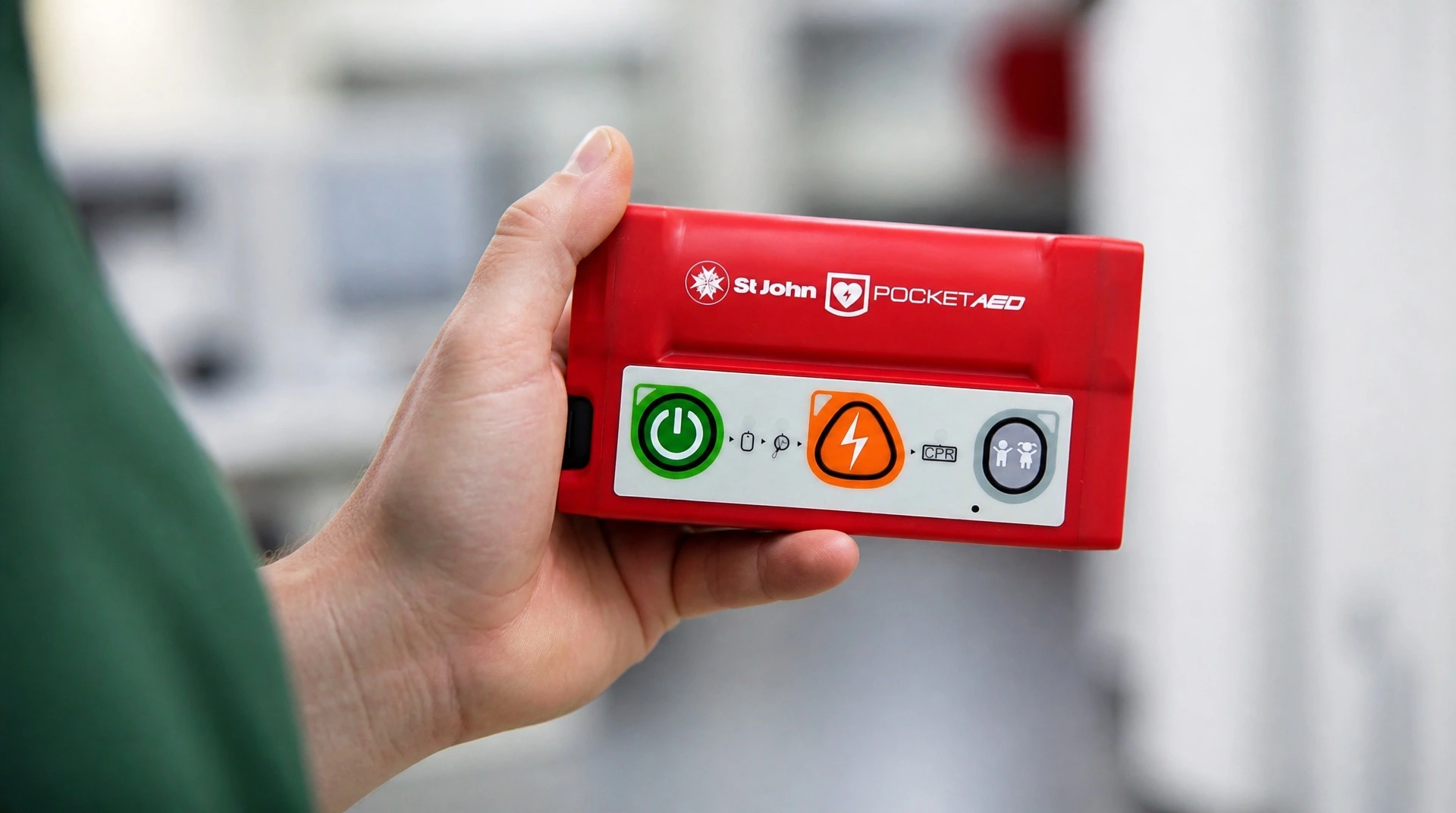
1 in 3 Australians have faced a medical emergency unprepared, when every second counts, St John launches pocket defibrillator
Every day, more than 80 Australians experience a cardiac arrest outside of hospital1,2 – most of them far from the nearest defibrillator. With survival chances falling by 7–10% for every minute without CPR and defibrillation,3,4 distance from a device is often the difference between life and death. The St John Pocket AED (Automated External Defibrillator) eliminates that distance.
- Caught unprepared: New research shows that 1 in 3 Australians (31%)5 have been in a situation where they wished they, or someone nearby, had been better prepared for a medical emergency,5 with 1 in 5 (19%) who felt completely helpless or tried to help but panicked and struggled due to lack of training or tools.5
- When every second counts: Early defibrillation alongside CPR can increase survival rates to as high as 70%2 – but only if a device is close at hand – most publicly accessible AEDs are in fixed locations.
- Survival made portable: The St John Pocket AED was built to close that gap. At just 700 grams, roughly the size of a soft drink can, it delivers the same clinical defibrillation capability as traditional larger devices in a format that fits in a glove box, a backpack, a first aid kit or a jacket pocket. Because in a cardiac emergency, immediate access to a defibrillator is critical for survival.
14 JULY 2026, SYDNEY – St John Ambulance Australia today unveiled what it is calling Australia’s Smallest Big Thing: the St John Pocket AED (Automated External Defibrillator). The organisation’s most significant product innovation to date, the Pocket AED is one of the smallest portable defibrillators on the Australian market – designed to help save lives by putting clinically capable defibrillation technology within arm’s reach when every second counts.
More than 30,000 Australians suffer a cardiac arrest outside of hospital every year.1,2 Of those, only 1 in 10 will survive.1,2 Whilst defibrillators are increasingly part of our public spaces – cardiac arrests don’t happen on schedule, or in convenient locations. For the millions of Australians who work remotely, spend time outdoors, are involved in team sports, or manage teams across multiple sites, there has always been a gap. Because in a cardiac emergency, the device that matters most is the one within reach right now. Survival chances fall by 7-10% for every minute that passes without CPR and defibrillation3,4 – meaning that the distance between a patient and the nearest device can be fatal. The St John Pocket AED was designed to eliminate that distance.
“The St John Pocket AED is the device Australia has needed for a long time,” said Brendan Maher, CEO, St John Ambulance Australia. “We’ve taken the clinical power of a full-capability AED and put it into something you can carry every day, in any environment. This isn’t a compromise, it’s a genuine advancement.”
The engineering behind the Pocket AED is as significant as its size. Despite its compact form, the device delivers a biphasic shock of 150 joules for adults and 50 joules for children – equivalent to larger AED models on the market. Clear, calm voice guidance supports users through high-stress emergency moments, a CPR metronome assists with correct compression speed, and a one-touch child mode ensures the device is ready and suited to the patient. Rugged, weather-resistant and drop-tested, the St John Pocket AED is built to perform wherever life takes you – from the tradie’s Ute to the hiking trail, the sporting sideline to the worker travelling between sites.
The launch comes as national data reveals a disconnect between where Australians believe defibrillators should be, and where they actually are. A YouGov survey commissioned by St John found that 96% of Australians believe AEDs should be accessible at sporting venues,6 and 76% say access in vehicles is important6 – rising to 85% among Millennials6 and 78% among Gen Z.6 Yet not enough sporting clubs, vehicles, or first aid kits currently carry one.
Meanwhile, 82% of Australians say access to a defibrillator at home is important,6 yet AEDs in the home are still extremely uncommon.
The gap between expectation and reality is even more confronting when viewed alongside separate St John-commissioned research which found that only 28% of Australians feel confident that a stranger nearby would be able to help them – by calling 000, performing CPR, or using a defibrillator – if they suffered a cardiac arrest in public.5 For the vast majority, the fear of being in the wrong place at the wrong time is entirely justified.
“Cardiac arrests don’t follow rules about location or timing,” said Sally Fenton, St John Paramedic. “They can happen anywhere. The clinical evidence is clear – early CPR and defibrillation dramatically improves survival outcomes when an AED is applied within the first few minutes.”
Critically, it has been designed so that anyone can use it. No prior training is required. The device analyses the heart rhythm automatically, provides step-by-step voice instructions, and will only advise to deliver a shock if one is clinically indicated.
While the Pocket AED puts life-saving technology within arm’s reach, St John emphasises that equipment works best alongside knowledge. Current YouGov data shows that only 39% of Australians have completed first aid training in the past three years6 – and that confidence to act in an emergency is directly linked to the recency of that training. St John strongly encourages all Australians to keep their first aid and CPR skills current.
As a national for-purpose organisation, St John reinvests proceeds from product sales — including the Pocket AED — into community first aid training, volunteer programs and health initiatives across Australia.
“1 in 3 Australians have already been in an emergency where they or someone nearby wasn’t prepared enough,” said Brendan Maher. “That is not a statistic we can accept. The Pocket AED is St John’s commitment to changing it – putting clinically capable, easy-to-use life-saving technology into the hands of everyday Australians, wherever they are. Whether you’re on the sporting field, at work, or out in the community, with the St John Pocket AED, help is already here.”
The St John Pocket AED is available now at shop.stjohn.org.au and through St John state and territory sales teams.
The St John Pocket AED is designed as a first response tool, not a substitute for emergency medical care. Always call 000 immediately in an emergency.
About the St John Pocket AED: The St John Pocket AED is an ultra-portable, next-generation AED designed to be carried anywhere. Weighing just 700 grams, it delivers full biphasic defibrillation capability (150J adult / 50J child), real-time voice guidance and CPR metronome support, automatic heart rhythm analysis, a one-touch child mode, stored ECG data, daily self-testing, IP65 weather and dust resistance, a 1.5-metre drop-test rating, Bluetooth/4G/GPS connectivity via a subscription with the CardiLink app, 4-year pad and 3-year battery life, and a 5-year warranty from date of manufacture. RRP $1,995 (AUD). Available at shop.stjohn.org.au.
Media Contacts
Yvette Schlegelmilch
yvette.schlegelmilch@stjohnnsw.com.au
0423 954 224
General Media Enquiries
media@stjohnnsw.com.au
(02) 9745 8799
References
- Australian Resuscitation Outcomes Consortium (Aus-ROC). Epistry – Cardiac Arrest Annual Report 2024. www.ausroc.org.au/wp-content/uploads/2025/01/Epistry-Annual-Report-2022-data-changes-07.01.25.pdf. Accessed May 2026.
- Heart Foundation – Shockingly Simple. https://www.heartfoundation.org.au/shockingly-simple. Accessed May 2026.
- Ibrahim WH. Postgrad Med J 2007;83:649–54.
- Larsen MP et al. Ann Emerg Med 1993;22:1652–8.
- Pureprofile. Responding to a Medical Emergency. June 2026.
- YouGov. First Aid Survey. September 2025.
St John
Pocket AED
Learn more about the St John Pocket AED – the defib designed to be carried.