
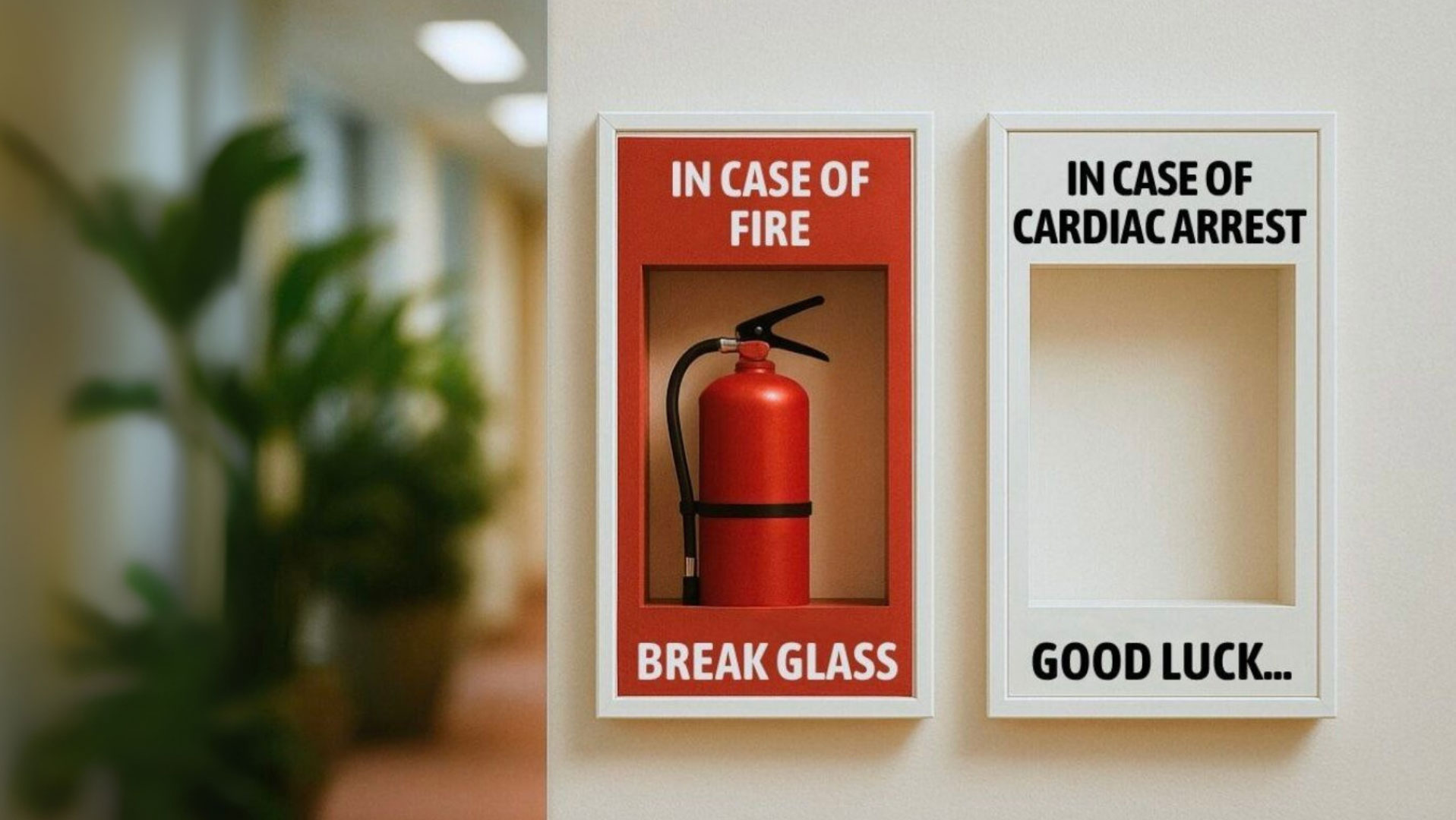
The most dangerous thing missing in Australian workplaces
You wouldn’t dream of running a workplace without a fire extinguisher – but most still do without a defibrillator (AED), the only device that can restore a normal heart rhythm in the event of sudden cardiac arrest. While fire safety is heavily regulated and universally understood, cardiac emergencies remain an overlooked risk — even though they strike unexpectedly and can happen in any setting, including the workplace.
Cardiac arrest is more common than you think
Each year, around 30,000 Australians suffer an out-of-hospital cardiac arrest – roughly 70 people every day. With survival rates as low as 10 percent, only about 1 in 10 people survive. In New South Wales alone, more than 8,5000 OHCAs occur each year. In 2021, 9,273 cardiac arrest patents were attended to in NSW.1
When a cardiac arrest strikes, every minute without CPR or defibrillation reduces the chance of survival by 10%, making access to a defibrillator (AED) a critical factor in whether someone lives or dies.2
Despite these stark numbers, awareness and preparedness remain low.
Cardiac arrest vs fire: A stark risk imbalance
In contrast, Fire and Rescue NSW report responding to just over 6,000 structure fires each year. These incidents include fires in homes, commercial buildings, industrial facilities, and public venues – essentially any building with walls and a roof. While these events are serious and sometimes deadly, fatalities from structure fires in NSW typically range between 15 and 20 per year, even when residential buildings are included, according to Fire and Rescue NSW data.3
According to the FRNSW Adverse Structure Fire Outcomes report covering 2016–2021, there were 88 fatalities resulting from structure fires over this six-year period, averaging approximately 15 deaths per year.4
“[AEDs] should be as commonplace in our homes, workplaces and public buildings, as fire extinguishers.”
Brendan Maher CEO, St John Ambulance Australia
Fire extinguishers are rightly mandated in nearly all public buildings and workplaces. Regulations require specific placement, signage, maintenance, and staff training. This level of readiness is accepted as standard safety practice.5
Yet AEDs, which address a far more frequent life-threatening emergency, are still not required by law in most Australian workplaces. This imbalance points to a broader issue: we’ve normalised being ready for fire, but not for cardiac arrest, despite clear evidence that both deserve equal urgency.
Fire extinguishers: Universally required and regulated
Under the Building Code of Australia (BCA) and Australian Standard AS 2444, fire extinguishers must be installed in all public buildings and workplaces. At a minimum, one extinguisher is required per building, with specific placement rules – for example, Class A units must be within 15 meters of any point in a building, and Class E within 20 meters.6
They must be mounted at a height of 0.1 to 1.2 meters and clearly marked with signage visible from at least 20 meters away. Certified professionals must inspect them every six or twelve months, and staff must be trained in their use. These comprehensive, enforceable regulations make fire extinguishers a universal and essential part of workplace safety.
AEDs: Life-saving but optional?
AEDs are not mandated by law in NSW or most other Australian jurisdictions.
However, the Work Health and Safety Regulation 2011 (Cth) advises employers to consider AED availability if there’s a risk of cardiac arrest, limited ambulance access, or large crowds.7 Despite this guidance, AED accessibility remains optional and inconsistent.
Emerging legislation: South Australia leads the way
“Even though perhaps more than 30,000 people die from SCA [Sudden Cardiac Arrest] every year in Australia, there is scant distribution of defibrillators—either at the workplace or in public places.”
Dr. D.P. Dingsdag Journal of Occupational Health and Safety, Australia and New Zealand, 2009.
In 2022, South Australia became the first Australian state to mandate public access to defibrillators, passing the Automated External Defibrillators (Public Access) Act. The legislation requires AEDs to be installed in high-traffic and high-risk locations such as shopping centres, aged-care facilities, sporting venues, schools, and gyms. It also mandates that AEDs be registered, accessible to the public, and regularly maintained, with penalties for non-compliance — setting a national benchmark for cardiac emergency preparedness.8
A similar bill was introduced in New South Wales in 2024. The Automated External Defibrillators (Public Access) Bill proposed mandatory AED installation and registration in comparable public settings, including shopping centres, sporting facilities, community venues, and potentially public transport. It also called for a central registry and requirements to ensure AEDs were properly maintained and accessible during emergencies.
However, the bill lapsed in April 2024 after failing to progress through Parliament within the required timeframe. It would need to be reintroduced in a future sitting to be reconsidered.9 As of June 2025, no updates have been announced. While not yet law, the bill reflects growing momentum toward nationwide consistency in AED access.
Other states, including Western Australia and Victoria, are reportedly exploring similar legislation.10
Public perception vs reality
Despite the prevalence of cardiac arrest, awareness and access to AEDs remain low.
A 2023 survey found that nearly 60% of Australian workers didn’t know where the nearest AED was in their workplace — even though 1 in 5 had been in a situation where one was needed for themselves or someone they knew.11 Alarmingly, almost half of workers said their workplace didn’t have an AED at all.
Public support is strong: 96% of Australians believe AEDs should be publicly available, according to a 2023 survey by St John Ambulance.12 While over 2,000 AEDs have been installed in NSW community sports venues through government grants,13 many workplaces and public buildings still lack them.
This highlights a serious gap in workplace emergency preparedness — especially when compared with the strong regulatory framework surrounding fire safety. AEDs, like fire extinguishers, can save lives. But until they are treated with equal urgency, avoidable deaths will continue.
Busting Myths
“AEDs are too expensive.”
Modern AEDs cost roughly $2,000–$3,000, comparable to other safety equipment like fire extinguishers or smoke alarms.
“There’s no need – cardiac arrest won’t happen here.”
Sudden cardiac arrest can strike anyone, anywhere, anytime, including healthy individuals in office, retail, warehouse or community settings.
“I might shock someone by accident.”
AEDs analyse the heart rhythm and only deliver a shock if it’s medically necessary; you can’t harm someone by using one incorrectly.
“We’ll wait for the ambulance.”
Every minute without defibrillation reduces survival by 10%. Ambulance response times often exceed this critical window
“You need medical training to use one.”
AEDs are designed for untrained bystanders. They give clear, step-by-step voice instructions and are safe for anyone to use.
“We already have a first aid kit – that’s enough.”
AEDs treat cardiac arrest, which a first aid kit cannot. They’re a critical tool that complements CPR, not replaces it.
Time to Balance the Safety Equation
Fire extinguishers save lives and remain a cornerstone of workplace safety. So too should AEDs.
With cardiac arrest causing thousands of deaths annually, and AEDs proven to dramatically improve survival when used quickly, it’s time for AEDs to join fire extinguishers and smoke alarms as standard emergency equipment.
Treat AEDs as essential – not optional.
What can your workplace do?
- Install an AED in an easily accessible location
- Register it with your state’s AED registry
- Include it in WHS and first aid protocols
- Train your staff to use it confidently
- Conduct regular checks on its battery and pads
“Having an AED close by and knowing how to use it can be the difference between life and death. We want to empower communities to act before paramedics arrive.”
Ryan Park MP NSW Minister for Health
Find out more shockingly interesting facts about defibs, including how to get one for your workplace.
References
1. NSW Ambulance (2022) Year In Review 2021–22
2.ANZCOR (2025) Guideline 7 – Automated External Defibrillation in Basic Life Support
3. Fire and Rescue NSW (2023) Annual Report 2022–23
4. Fire and Rescue NSW (2023) Adverse Structure Fire Outcomes 2016–2021
5. Fire Regulations Australia. AS 2444:2001 Portable Fire Extinguisher and Fire Blankets
7. Work Health and Safety Act 2011 (2025) Regulation 42: Duty to Provide First Aid
8. South Australia Government (2022) Automated External Defibrillators (Public Access) Act 2022
9. New South Wales Government (2024) Automated External Defibrillators (Public Access) Bill 2024 (No 3)
11. Philips Australia (2023) Where Is Your AED? Survey Report
12. St John Ambulance Australia (2024) Public Access AED Survey
13. Office of Sport NSW (2024) Life-Saving Defibrillators Available for NSW Sports Facilities
QUOTES
Ryan Park MP, NSW Health (2024) Connecting Good Samaritans to Defibrillators Will Save Lives