
A 19-month-old stops breathing over his breakfast. His dad has precious seconds to remember what he learned three weeks earlier in a first aid course. This is that story – and the numbers behind why every parent, carer, and bystander should know what to do.
Australia’s Institute of Health reports that there are roughly 450-500 choking related deaths annually in NSW with children 0-4 and adults over 65 most at risk. NSW Ambulance report between 2000-3000 triple zero calls for acute choking where paramedics are dispatched, with critical choking incidents handled as priority one. These figures highlight that whilst many choking incidents are cleared with a cough or a drink of water, when the blockage is complete—when no air gets in and no sound gets out—the outcome is very different: brain damage can occur in as little as 3 minutes and death can follow in 5-10 without intervention. Survival in an acute choking situation comes down to whoever is standing nearest, and whether they know what to do.
What happened to Ben’s son
Ben Getley, father and recent attendee of a St John first aid course, found out firsthand what that moment looks like when his 19-month-old son began choking on a breakfast bar.
Ben noticed something was wrong when his toddler suddenly stopped making any noise at all and his lips began to turn blue. There was no time to think it through. Ben went straight into action, using knowledge he’d gained from a first aid course only a few weeks earlier, recognising the signs of a complete airway blockage, and knowing he needed to act immediately.
“I’m so lucky that I had only recently completed my first aid training, which meant I knew exactly what to do when my son started choking. Without my first aid training I would have had no idea what to do and I fear that the outcome could have been very different.”
Using what he’d learned, Ben cleared the obstruction from his son’s throat within minutes, and his son made a full recovery.
The basics everyone should recognise
A first aid course is where you actually build the muscle memory and confidence to act under pressure; that’s what makes the difference on the day, not reading a list. But there are a few key things worth knowing regardless, if only so you recognise what’s happening and know to act and call for help:
- Check first. If the person can still cough, speak, or breathe, let them keep coughing: it’s the most effective way to clear a partial blockage. Only step in physically if they can’t make a sound, can’t cough, or are struggling to breathe at all.
- Get consent if you can. If they’re conscious, a nod or thumbs up is enough – they usually can’t speak.
- Lean them forward and support their chest with one hand.
- Give up to five back blows, using the heel of your other hand, firmly, between the shoulder blades. Check after each one to see if the blockage has cleared.
- If that doesn’t work, give up to five chest thrusts. Stand in front of them, ideally lean them against something sturdy (a wall if they are standing, the back of a chair if sitting), place both hands in the centre of the chest like you are doing a compression, and push hard. Check after each one.
- Keep alternating. Five back blows, five chest thrusts, until the obstruction clears or the person becomes unresponsive.
- If they become unresponsive, move straight into DRSABCD and start CPR if needed – another core skill covered in a first aid course.
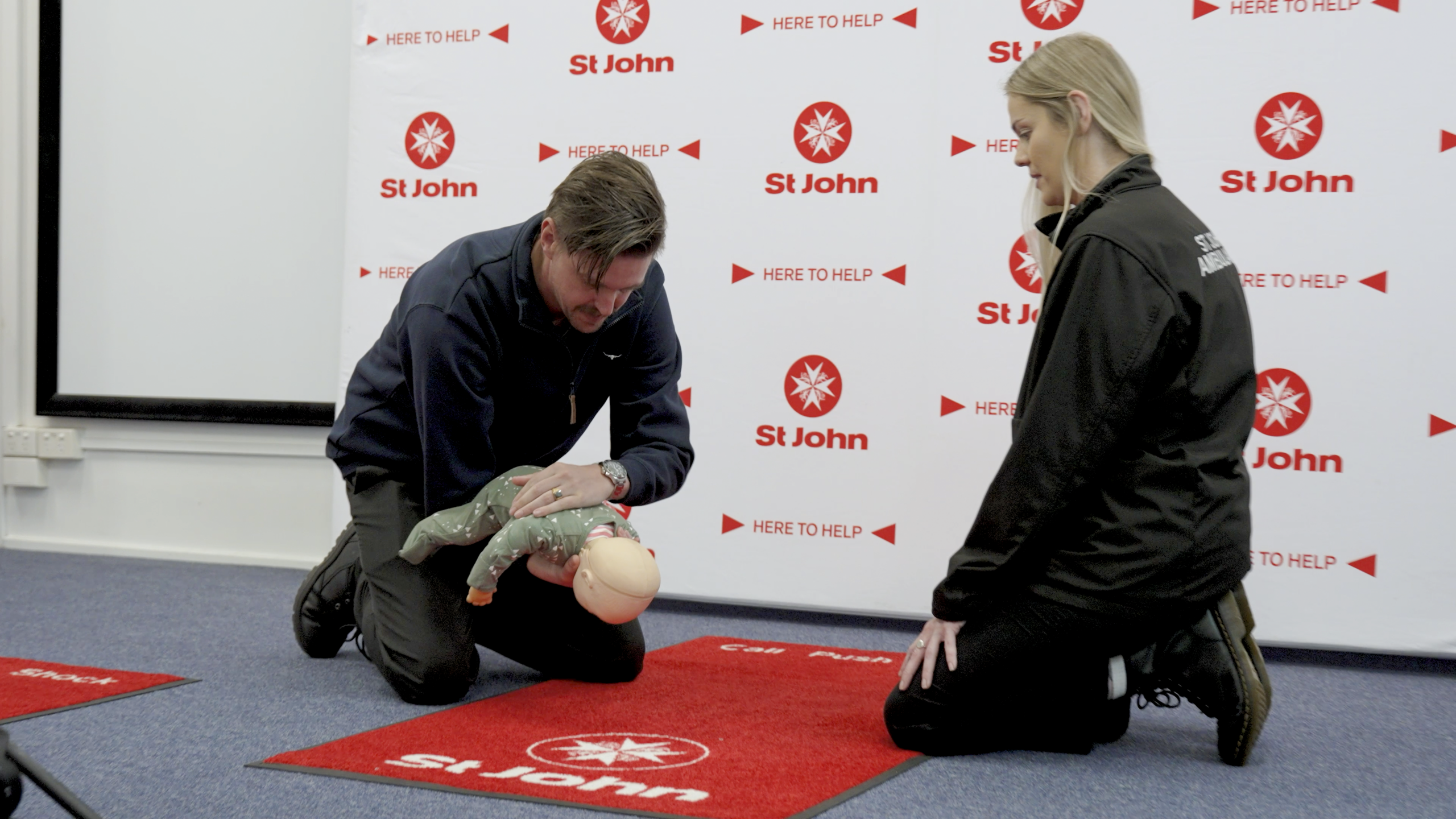
For infants like Ben’s son, the child can be supported face-down along your forearm rather than standing.
Knowing the exact sequence of actions without having to think and having the confidence to perform them effectively is the kind of judgement call that only comes from practising it hands-on with a trainer, not from a list on a page.
This is exactly why a first aid course exists: not to hand you a script, but to put you through the scenario enough times that your hands know what to do before your brain has finished catching up.
Why the response rate matters
The figures referenced earlier are sobering, but they’re not the whole picture because choking is one of the few emergencies where a bystander’s response genuinely changes the outcome. A study out of Canada, published in the Resuscitation Journal, found that bystander treatment of giving back blows and chest thrusts cleared the airway 76.5% of the time.
The takeaway
Ben’s story is a timely, and deeply human, reminder that basic first aid skills can be the difference between a terrifying moment and a tragedy. It’s also a reminder that the Australian Resuscitation Council and St John recommend refreshing your first aid training every three years and your CPR every twelve months because knowing the theory once isn’t the same as your hands knowing what to do when it counts.
Make sure you know how to act in the moments that matter. Book your St John first aid course now.